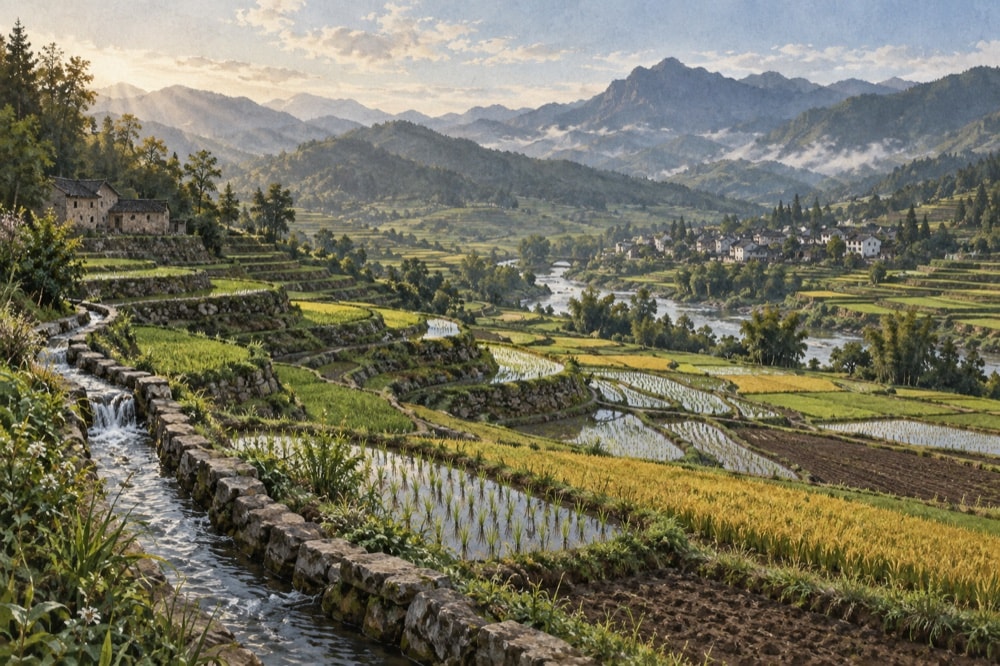
| 900 Million Farmers
in China
The history of reform and opening up has witnessed
three calls for the development of rural markets. 900 million farmers constitute the
world's largest group of consumers and have created the biggest business opportunity in
China.
In the face of the dual competitive pressure posed
to China by the hi-tech advantage of the developed countries and the price advantage
resulted from the currency devaluation in surrounding countries, China has clearly
indicated: From the long-term point of view, while actively exploring international
markets, it is essential to actively develop the domestic market, particularly the rural
market. This is a strategic choice in conformity with China's national conditions.
The rural market is the most dynamic, practical
pivotal point in expanding domestic demands and boosting economic growth. Inadequate
effective demand has become the greatest hindrance to China's current economic
development. In the series of macro-control measures to be adopted in the second half of
this year, exploring the rural market is regarded as "a rope for capturing the
tiger". Experts' estimation indicates: Every 100 billion yuan worth of final
consumption realized in rural areas will generate 235.6 billion yuan worth of consumption
demand for the entire national economy.
It is also a brand-new starting-point in the
readjustment of economic structure and the readjustment of product mix. Today, the buyer's
market has penetrated to every corner of China's economy. Of the 900-odd important
industrial products, the utilization rate of over half of the production capacity is less
than 50 percent, structural readjustment is thus imminent.
In the effort to successfully open up the rural
market, industrial enterprises must produce commodities geared to rural demands; and
commercial enterprises must skillfully build smooth and swift marketing channels.
There are many difficulties confronting the effort
to explore rural markets. Reasons for this are many. For example, some local governments
have inadequate understanding of the importance and urgency of exploring rural markets,
fear difficulty and lack confidence in accomplishing this task; quite a number of
industrial and commercial enterprises still harbor the concept of "valuing cities
while belittling the countryside", this is manifested in the fact that the product
mix is incompatible with the rural market demand, the variety of commodities on sale is
single and farmers find it inconvenient to buy.
In fact, the rural market has enormous potential and
there are many favorable conditions for developing the rural market. So long as industrial
and commercial enterprises really attach importance to the rural market, carefully study
farmers' demands, exert great efforts to do a good job in the work of exploring the rural
market well, they can definitely achieve the anticipated results.
Industrial enterprises stress production of
commodities geared to market needs, while commercial enterprises emphasize smooth and fast
marketing channels.
Efforts should be made to develop new sales methods,
such as chain-store, agency and distribution center and to establish various forms of
sales networks wherein industry and commerce, commerce and commerce, town and country,
state-owned commerce and individually-run and privately-run commerce join hands. Chinese
business people will have ample scope for their abilities in rural markets.
The key to success in exploring rural markets lies
in increasing farmers' income. It is necessary to open up the rural consumer goods market
to allow farmers to buy things; and it is also necessary to first open up the rural
agricultural produce market, so that farmers' purses will be bulging
Farmers' income is stepping into the period of a new
round of growth at reduced rate.
Slow increase in farmers' income is the greatest
factor thwarting efforts to explore rural markets. When farmers' purses are not so
bulging, increase in actual consumption demand will be slow. To increase farmers' income
is, in essence, to enhance the rural economy's adaptability to the socialist market
economy. In the opinions of authoritative persons, it is essential to get hold of two
links: one is "what to grow". Farmers have to grow farm crops easy to yield
added value.
To do so, it is necessary to readjust and optimize
the agricultural structure, develop high-efficiency and high-value-added characteristic
agriculture. Second is "how to sell the produce". To increase farmers' income,
it is essential to solve the problem concerning ties between the farmer and the market,
farmers should be enabled to smoothly enter the big, ever-changing market. This requires
development of industrial management of agriculture, and cultivation of a wholesale market
system, intermediary service system and information service system.
Cultivating a wholesale trading market system by
making use of the advantages of tradition, regional location, resources and industry is an
important aspect in invigorating the flow of agricultural produce and industrial products.
This has been proved by the experience of many localities.
China May Hold Future of Food Technology
By Dennis Avery
Senior fellow and Director,
Center for Global Food Issues at
the Hudson Institute
Is
it possible the First World will give China a virtual
monopoly in agricultural biotechnology, destined to be one
of the most valuable technologies of the 21st century?
Have
the United States and Europe thrown away billions of
dollars in agriculture-related biotech earnings and
hundreds of thousands of clean, high-tech research and
support jobs?
The
United States and Europe have spent billions of dollars
doing basic research in genetically modified crops and
animals to make foods that are better-tasting, more
nutritious and kinder to the environment.
Will
China now step in and charge the United States and Europe
steep royalties for the right to grow the new organisms
that result from this research?
Those
are all strong possibilities, in the wake of the
environmental group Greenpeace's stunningly swift and
successful campaign to ban genetically modified foods and
crops.
First
World investors were afraid to be caught in another
controversy like tobacco, or another set of baseless
class-action lawsuits like the controversy over silicone
breast implants.
They've
bailed out on agricultural biotechnology long before
governments dared act. To duck the controversy, Monsanto's
orphaned agricultural biotech unit will be dumped into a
hostile stock market along with its multibillion-dollar
laboratories and patents.
Ditto
for the big agricultural biotech units of Europe's
Novartis and Zeneca. Look for layoffs from all three. And
don't expect the laid-off scientists to land jobs at
public research institutions.
The
publicly funded research labs will be even more gun-shy of
agricultural biotechnology now than the private sector.
The erstwhile scientists will have to lay aside their
doctorates and start new careers.
A
lucky few may find jobs in human medical biotech, which
the environmental movement has not attacked yet. This has
nothing to do with risks to people or the environment.
Despite media hype, no real dangers related to biotech
foods have ever been documented.
But
Greenpeace seems to want a smaller, poorer human
population, so they're willing to frighten the world back
into the scientific Dark Ages. The one thing certain is
genetic engineering in food production will not disappear.
When
the astronomer Galileo published his proofs in 1632 that
the Earth revolved around the sun, the Catholic Church put
him under house arrest. The church had declared the Earth
the center of the universe. But people could never look at
the sun in quite the same way again. They had new
knowledge.
The
First World may be so comfortable it can afford to pass up
biotech foods. But the Third World is still struggling to
provide adequate diets for its growing population.
For
the developing world, the choices are stark. The can
either use biotechnology to raise yields, grow more
low-yield crops by clearing tropical forests or import
food from the West. Given those choices, biotech foods
look awfully attractive.
Most
Third World countries are too small or poor to advance
agricultural biotechnology on their own. Countries like
Brazil and Argentina could assemble the scientific
resources but they're afraid of losing their export sales
to nervous European and Japanese consumers.
India
might like to develop high-yielding biotech crops to ease
its cropland shortage, but its own prickly activists are
still arguing over hybrid seeds. They're likely to
hamstring Indian biotech into the near foreseeable future.
China
is the one country in the world with the scientific power
to carry biotechnology forward in agriculture, the urgent
need for massive amounts of additional food and feed and
no need to allow unfounded food scares to be published in
its newspapers.
China
already has over 1 million farmers growing genetically
modified cotton, corn and soybeans because of lower costs.
Anyone who doubts China's ability to carry forward good
science is ignoring the country's fabulous history and its
recent ballistic missile tests.
"Golden
rice" by itself may be enough to secure genetically
engineered foods' reputation among Chinese consumers.
Asian women are at high risk of birth complications
because of iron deficiency due to the phytate in the rice
they eat.
Golden
rice counteracts the phytate and provides ample dietary
iron. It also contains plenty of Vitamin A, also lacking
in many rice-culture diets.
The
International Rice Research Institute is already breeding
golden rice genes into popular rice varieties for the
people of Asia and Africa. Is Greenpeace callous enough to
try to frighten poor rice-culture consumers away from
golden rice and back to childhood blindness?
Using
biotechnology, China should be able to produce highly
attractive foods, such as healthier fats for cooking,
allergy-free nuts, more tender steaks and, at last, a
tasty off-season tomato.
Every
vitamin and mineral needed by the human body could be
engineered into our foods, saving consumers billions of
dollars in food supplements.
When
First World consumers find out about such goodies, China
can export them or charge farmers in other countries a fee
to grow them.
The
biotech crops will also feature sharply higher yields,
especially on marginal farmlands where drought and acid
soils currently limit production. Greenpeace should cheer
this, since it will directly help save Asian tropical
forests.
First
World farmers will lose a significant part of their export
potential, of course, if Third World farmers can produce
higher yields and more desirable specialty foods through
biotechnology. At the moment, that seems to be the price
they pay for farming in a rich, overfed country.
**Dennis
T. Avery is based in Churchville, Va., and is director of
global food issues for the Hudson Institute of
Indianapolis.
|